A PRACTICAL, NO-HYPE GUIDE TO EVERYDAY WELLNESS HABITS
GUIDE INDEX / SCORED REVIEWS / NEURORECALL
Focus & Memory Habits · Scored Review

NeuroRecall, scored: a familiar 151 mg formula under a new name, and the order funnel around it

NeuroRecall is a once-a-day capsule sold through online ads to adults who want to stay sharp. On October 9, 2026 we followed the ads' lookalike sites to the one checkout they feed, read the seller's own label, walked every post-purchase offer, and scored what we found.

By The Living Well Guide Editorial Team · Published October 9, 2026

The Verdict

Our score, and how we got there

Five things we can check without taking anyone's word for it, each rated out of 5.

1.5 / 5
Not recommendedThe label is real and readable. Almost nothing around it matches it.
  • Label transparency (vitamins dosed, blend not)2.5
  • Evidence for the formula at this dose1.5
  • Who stands behind it1.0
  • Price, upsells and refund terms1.5
  • Honesty of the marketing around it1.0

The overall figure is the plain average. No study of NeuroRecall itself has been published, and we didn't test it on people.

The Label

What the bottle actually lists

Transcribed from the label artwork served on the seller's order page, October 9, 2026.
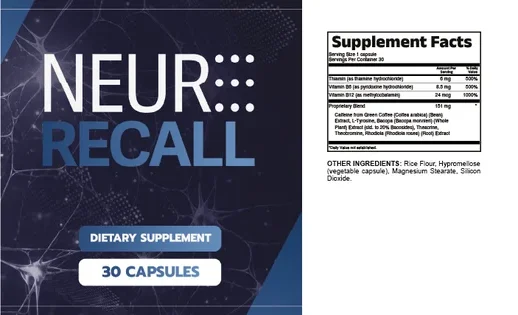
Flat NeuroRecall bottle label: front panel reading Dietary Supplement, 30 capsules, beside the Supplement Facts panel and other ingredients
The seller’s label artwork, cropped to the front panel and the Supplement Facts; the side text with directions, distributor details and the standard disclaimer is left out.

One capsule is a serving, and a bottle holds 30. The dosed part is three B vitamins: 6 mg of thiamin and 8.5 mg of B6 (each listed at 500% of the Daily Value) plus 24 mcg of B12 in its methylcobalamin form (1000%). The rest is a 151 mg proprietary blend whose contents appear in this order: green coffee bean extract as a caffeine source, L-tyrosine, a bacopa extract standardized to 20% bacosides, theacrine, theobromine and a rhodiola root extract. None of the six has its own amount. The capsule shell is hypromellose, with rice flour, magnesium stearate and silicon dioxide as fillers and flow agents. The suggested use is a single capsule daily with a glass of water, 20 to 30 minutes ahead of a meal.

Two things stand out. Half the blend is stimulant-type compounds (caffeine, theacrine, theobromine), and the caffeine figure is never printed. And 151 mg covers all six blend ingredients together, so its bacopa, rhodiola and theacrine can't reach the daily amounts used in the trials below.

Name Check

Have we seen this formula before? Yes, nearly line for line

Comparing NeuroRecall's label with two products we have already reviewed.

DetailNeuroRecallGolden Brain (our label check)
B vitaminsB1 6 mg, B6 8.5 mg, B12 24 mcgIdentical amounts
Blend total151 mg151 mg
Blend contentsSix items, listed aboveThe same six, plus Huperzia serrata
Inactive ingredientsRice flour, hypromellose, magnesium stearate, silicon dioxideSame four
Address on labelP.O. Box 12730, Ogden, UtahA P.O. Box in Ogden, Utah
Bundle prices2 for $158, 3 for $207, 6 for $294Same three prices

One storefront for NeuroMind, a third ad-driven memory product reviewed by a sister site, lists the same vitamin trio and seven blend names as Golden Brain, which we covered separately. NeuroRecall is that recipe minus Huperzia serrata, same blend total. We can't see inside the factory, but the published labels match apart from that line. The Ogden P.O. Box alone proves little, since many unrelated brands use it; the matching milligrams, inactive list and prices are the stronger signal.

The Name Map

Where the NeuroRecall sites really send you

None of these sites is linked from this page, by policy.

Searching the name turns up more than a dozen misspelled look-alike domains, each claiming to be official. We clicked the order buttons on eleven of them. Four (neurorecalls.com, neuroo-recall.com, neuroorecall.com and neurorecallreviews.com), plus theneurorecall.shop, the site named in an October 8 press release, passed through an affiliate tracker to the same order page, the one carrying the label above. Five others (theneurorecall.com, neurrorecall.com, neurorrecall.com, neurorecallshop.com and neurorecallstore.com) talked about NeuroRecall and then handed the shopper to a checkout for MemoHoney, a different, honey-themed product. One more, neurorecall.us, sent its buttons to a nerve-comfort product called Nerve Harmony.

Their ingredient stories rarely match the bottle. Several describe a capsule built on ginkgo, L-theanine and phosphatidylserine; a couple add acetyl-L-carnitine; some insist there is no caffeine; others say no ingredient list exists. The press release names ginkgo, bacopa, L-theanine, B12, phosphatidylserine and rhodiola. Only bacopa, rhodiola and B12 are on the real label, alongside three stimulants.

The Research

What the studies support, and at what dose

None of this research tested NeuroRecall. It describes the named ingredients at the amounts researchers used.

Bacopa has the most research behind it of anything in the blend. Pase and colleagues (2012) pooled six placebo-controlled trials, each lasting 12 weeks, in adults with no significant cognitive impairment; bacopa beat placebo on 9 of the 17 free-recall tests used, and other mental skills showed little change. Those trials gave 300 to 450 mg of extract daily. Kongkeaw and colleagues (2014) analyzed nine trials with 518 participants and saw the most consistent gain in attention speed, while asking for larger, better-designed studies. Because the whole NeuroRecall blend weighs 151 mg, about one third to one half of a single trial dose, and is shared six ways, its bacopa share has to be smaller still.

L-tyrosine is an amino acid the body uses to make dopamine and noradrenaline. Jongkees and colleagues (2015) concluded it may support performance during brief, acutely stressful or mentally taxing situations, chiefly when those chemical messengers are running low. Theacrine has been tested in people mainly for safety: an eight-week trial gave 60 healthy volunteers in their early twenties 200 mg or 300 mg daily, either of which exceeds NeuroRecall's entire blend; it measured blood-safety markers and self-rated energy and focus, not memory. A 2011 systematic review of eleven placebo-controlled rhodiola trials found possible benefits for physical and mental performance but called for better research.

For caffeine, the FDA cites about 400 mg a day as generally not linked to negative effects in healthy adults, though sensitivity varies. Without a printed amount, you can't count NeuroRecall against your coffee. The B vitamins are clearly dosed, but we found no evidence that extra B6 or B12 sharpens memory in people who already get enough.

Red Flags

What the checkout and post-purchase pages showed, October 9, 2026

A post-purchase letter signed with a well-known TV doctor's name

After the first upsell, a discount page carries a long letter signed with a well-known TV doctor's name. In the seller's words, the bottles are a "protocol," three months is the minimum for "memory recovery," and stopping early leads to "regression." Those are the seller's terms, not ours. We found nothing showing the named person wrote or approved it, and the FTC warns that fake celebrity recommendations are common.

A category already linked to deepfake video ads

In June 2026 the Better Business Bureau warned about AI-generated videos of famous public figures pitching honey-based memory remedies to older adults. Five of the NeuroRecall look-alike sites we tested send their order buttons to a honey-themed memory product. We didn't trace a specific video to NeuroRecall. Still, if a celebrity clip is what sent you to a NeuroRecall site, assume it is not genuine until the person's own channels confirm it.

Leftovers from other products, and no company name

The order page's guarantee script names a different supplement by default, another script lists about twenty glucose and insulin papers, and the footer carries an earnings disclaimer meant for money-making offers. The 12-bottle upsell is headed "Add 6 More Bottles." The seller uses two trading names and two support-email domains but names no legal entity, and the return address changes by page: the Ogden P.O. Box on the BuyGoods order page, a Largo, Florida street address in the upsell pages' refund pop-up, and an Aurora, Colorado warehouse on the domain's main page.

Price & Refunds

What an order costs, and what the guarantee covers

Checked on the seller's order and post-purchase pages, October 9, 2026.

2 bottles

$158 + $9.99 shipping

$79 a bottle, against a struck-through $179.

3 bottles

$207

$69 a bottle, free U.S. shipping.

6 bottles

$294

$49 a bottle, free U.S. shipping.

After payment the funnel offers 6 more bottles for $198 or 12 more for $348, then 3 for $72 under a five-minute timer, so a buyer who paid $79 a bottle is soon offered $24. Then come unrelated products, including a kit at $39 for the first month and then $167 a month until you cancel.

The guarantee depends on the checkout. The BuyGoods order page gives 60 days from shipping, every bottle returned after authorization, approved return shipping covered. The domain's main page sells the same bundles through another processor and promises 180 days.

What We'd Choose Instead

One ingredient, with the dose printed

Checked on Amazon.com, October 9, 2026.

This page links to no NeuroRecall site of any spelling. For readers mainly interested in bacopa, the ingredient with the deepest research file in that blend, we'd point to Himalaya Organic Bacopa. Each caplet lists 500 mg of organic whole-plant bacopa powder (10 mg saponins) plus 250 mg of whole-plant extract standardized to 24% saponins (60 mg), one caplet a day, 60 per bottle, from a brand dating to 1930. When we looked on October 9, Amazon showed it in stock for $25.99, shipped by Amazon, sold by Himalaya Wellness, with a 4.5 of 5 star rating from more than 5,500 ratings, and marked as not returnable because it is an ingestible item. Its extract portion is below the 300 to 450 mg used in the trials above, and it contains no caffeine.

See Himalaya Organic Bacopa on Amazon →

Or use the plain link: Himalaya Organic Bacopa, 750 mg, 60 caplets. As an Amazon Associate, The Living Well Guide earns from qualifying purchases. Prices and availability change; the listing shows current figures. Himalaya's printed caution: consult a healthcare practitioner before use if you are pregnant, nursing, taking medication, have a medical condition or are planning a medical procedure, and stop if any adverse reaction occurs. If you take prescription medication, check with a pharmacist first.

Common Questions

Quick answers

Is NeuroRecall stimulant-free?

Not according to its own label, which lists caffeine from green coffee bean, theacrine and theobromine. Several look-alike sites say otherwise; the label takes priority.

Sources: Pase MP et al. The cognitive-enhancing effects of Bacopa monnieri: a systematic review of randomized, controlled human clinical trials. J Altern Complement Med 2012;18(7):647-52 (PMID 22747190). Kongkeaw C et al. Meta-analysis of randomized controlled trials on cognitive effects of Bacopa monnieri extract. J Ethnopharmacol 2014;151(1):528-35 (PMID 24252493). Jongkees BJ et al. Effect of tyrosine supplementation on clinical and healthy populations under stress or cognitive demands: a review. J Psychiatr Res 2015;70:50-7 (PMID 26424423). Taylor L et al. Safety of TeaCrine, a non-habituating, naturally-occurring purine alkaloid over eight weeks of continuous use. J Int Soc Sports Nutr 2016;13:2 (PMID 26766930). Hung SK, Perry R, Ernst E. The effectiveness and efficacy of Rhodiola rosea L.: a systematic review of randomized clinical trials. Phytomedicine 2011;18(4):235-44 (PMID 21036578). U.S. Food and Drug Administration, Spilling the Beans: How Much Caffeine Is Too Much? U.S. Food and Drug Administration, Questions and Answers on Dietary Supplements. Federal Trade Commission, Health Products Compliance Guidance. Federal Trade Commission consumer alert, Did a celebrity really endorse THAT? Maybe not (April 24, 2024). NBC Chicago, June 30, 2026, on a Better Business Bureau warning about honey "memory trick" ads (not linked). The Living Well Guide's earlier Golden Brain label check, October 8, 2026 (not linked). Seller materials reviewed directly on October 9, 2026: the NeuroRecall BuyGoods order page with its label artwork and page scripts, each upsell and downsell page after it, and the same domain's main page with its second checkout and terms. Eleven look-alike NeuroRecall domains, opened that day to compare what they claim about ingredients and to follow each buy button to its destination. A NeuroRecall announcement distributed via GlobeNewswire on October 8, 2026, and the site it names. None of these seller or look-alike pages is linked, by policy. Amazon.com product page for Himalaya Organic Bacopa, 750 mg, 60 caplets, viewed October 9, 2026 (price, seller, availability, ratings, returns, label images). Nothing on this page is intended to diagnose, treat, cure, or prevent any disease.
Bottom Line

Where this fits, if it fits

The bottle label is the one straightforward document in the NeuroRecall funnel: three dosed B vitamins and a 151 mg, stimulant-heavy blend that has already appeared under at least two other product names. Around it, the look-alike sites describe different ingredients, a post-purchase letter carries a famous doctor's name, and the upsell chain ends in a monthly subscription for something else. Good sleep, regular activity and a talk with your own clinician do more for day-to-day focus than any capsule. If you still want a supplement, pick one that prints the amount of what you're taking, which is why our only link goes to a single-ingredient bacopa.

What you read here is based on NeuroRecall's publicly available label, pricing and refund information as of October 9, 2026, plus general published research on its named ingredients. Formulas, prices and the sites selling under this name can change without notice. These statements have not been evaluated by the FDA. This product is not intended to diagnose, treat, cure, or prevent any disease. This page contains affiliate links; see our Disclosure page for details.

This site uses cookies for essential function and, with your consent, ad measurement. See our Cookie Policy.